Glacier Ice Cave in Alaska

We are caved in, isolating ourselves from each other. Our world is changing because of an ominous virus that is stealthily spreading. Several weeks into this strange and troubled time, we practice social distancing, quieting down, finding a new normal. There are books to read, online courses to work on, lots of time to write. Luckily, the great outdoors in Alaska, vastly unpopulated, still provides us with opportunities to go outside. If we cannot regroup with others just yet, at least we can seek out venues where we are not likely to come into close contact with people.

“Let’s go see an ice cave!” I propose.

After several days indoors, the teenagers are immediately animated, not even balking at the idea of going for a hike, even if it means getting off the couch, sorting out winter gear, filling water bottles.  Eagerly, we leave our self-imposed den for a different type of cavern: the Castner Glacier Ice Cave.

IceCave1

It is an easy, straightforward hike, we were told, a manageable day trip from Fairbanks.  “Just drive past Delta Junction to the Castner Creek Bridge,” were the instructions.  “Then you’ll see cars parked at a pullout. That’s where the trail starts.” We drive, in snowy conditions, visibility low. Squinting through the windshield, we wonder about this excursion. Should we have picked a better day for this? We pass only a truck or two on the otherwise deserted road. Would we even be able to find a cave in such weather? But then, just beyond the bend and the bridge, in an otherwise people-less landscape, we see a row of parked cars. The trailhead.

On the creek bed, people are heading towards the glacier. We follow, pondering the wisdom of our boots when everyone else is wearing snowshoes. Not long into the walk, sinking knee deep with every step, no inkling of the so-called trail beneath our feet, we understand why.  Arms flailing, trying not to topple over, sinking into deep potholes, we must look like the epitome of gracelessness.  Helen tries to run quickly across untrodden snow in an effort to not sink but lands, face-down, in deep snow.  Yanni opts for a “short cut” across to the right riverbank, seemingly higher, less slushy, only to double-back to our original trail when he becomes stuck. Periklis, a Greek student Yanni brought home from college with him, gawks at the terrain, telling us he has never seen so much snow in his life.  I try to follow in Nick’s deep foot imprints, huffing and sweating with the exertion. Where is the leisurely walk we were promised?

IceCave5

There is no sign of a glacier cave until we practically stumble into it.  Hidden from sight, its opening suddenly gapes at us around a corner of the steep, snow-covered moraine. And then, we are literally beneath the glacier in an enormous ice cave.  We are astounded by its beauty. Formations of ice, scalloped along the cave roof, shimmer translucent and blue.  Further in, deep indentations in the walls are encrusted with hoarfrost and glitter in the half light.  Our feet crunch on ponded water that has frozen solid on the bedrock, reflecting shiny silvery light.  It feels as though we are in a fragile glass house that is nevertheless as massive and strong as the enormous glacier above us.  Silence grabs us as we take it in, almost as though we entered a sanctuary, one the earth has gifted to us. In time, the earth may reclaim it, as the cave shifts – widening, lengthening, melting, possibly collapsing. For today, however, we feel enriched, fortunate to simply have beheld it for an afternoon.

IceCave6

Ice Sculptures in Alaska

The sculptures, made of ice, are larger than life.

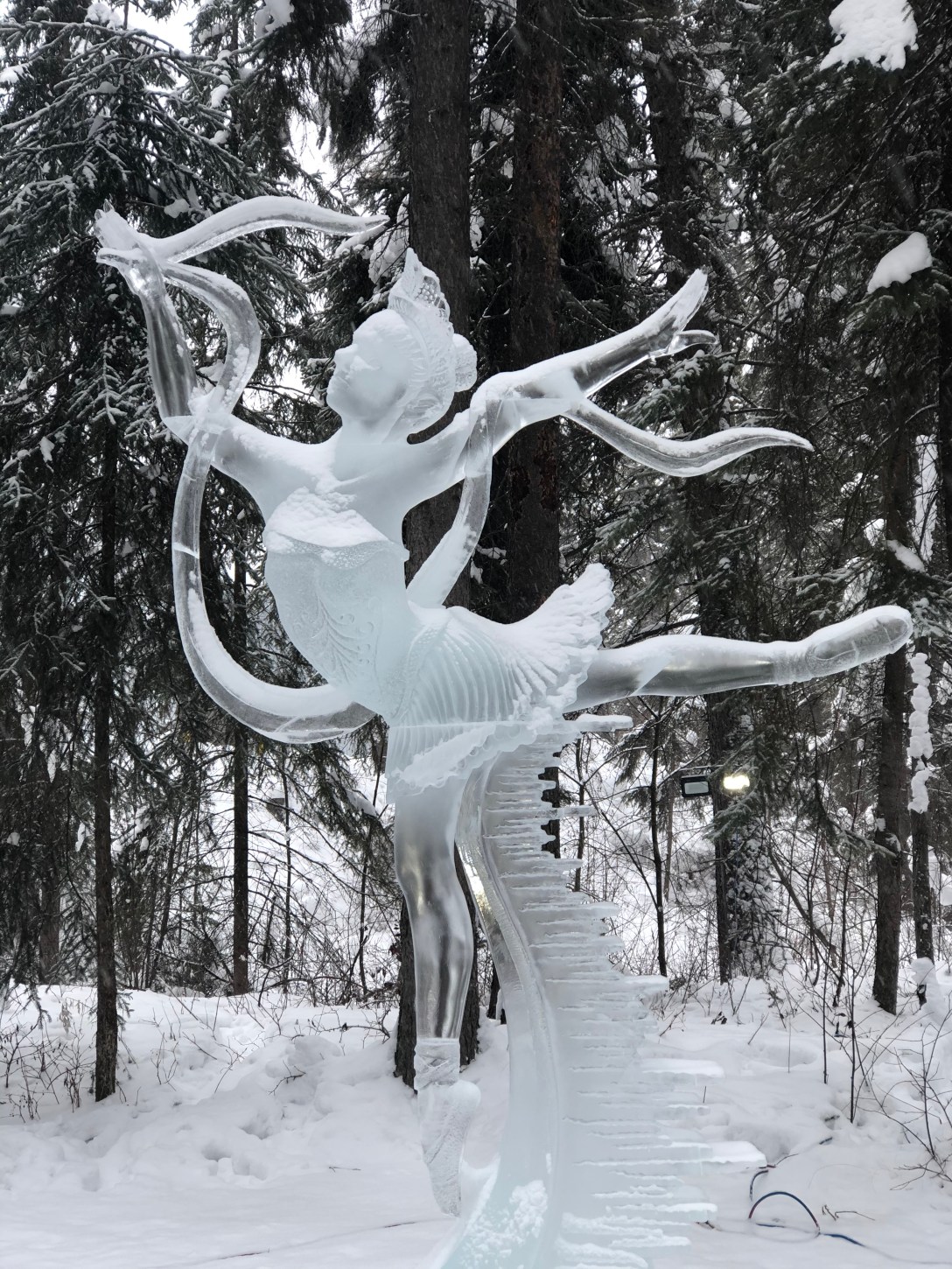
A snowy Sunday afternoon has drawn me to the ice park in Fairbanks. A competition is taking place, the World Ice Art Championship, one in which large blocks of ice, harvested from frozen ponds, are being transformed into exquisite works of art.  The sculptures stand in clearings between black spruce, some carved from a single block of ice, others assembled from multiple blocks.  The multi-block works are finished, detailed, lovely in composition. At the single block sites, many are still rough-hewn, in progress, as their sculptors work to liberate from the ice block the forms they envision in their heads.

I find my friend Heather Brice working on her sculpture.  She looks tired but smiles, determined, as she brushes the softly falling snow from her piece. She, like the other carvers, has been working practically around the clock for the past few days in order to meet the judging deadline. The effort shows in her piece: an elegant seahorse, polished and delicate, swimming upright.  Its unique anatomical shape is evident at once in the curvature of its neck, the down-pointing snout, its long tail, the hard, bony plates of its exoskeleton. True to its ability to change color to match its habitat in the sea, it has turned translucent to fit into the icy landscape. I gape, unable to comprehend that such loveliness can result from a rough block of ice.

IceArt2


It is a remarkable process. In this outdoor art studio of a black spruce forest, carvers use chainsaws, forklifts, chisels and picks, as they work with their medium in its various states of water.  The temperatures have remained far below zero most of the winter, both aiding and hindering their progress.  The frozen ice, strong and dense, is less likely to fissure and crack when supports are sawed away.  On the other hand, challenged by such numbing conditions, wearing parkas and mittens and facemasks, these artists are most certainly among the most stoic in the world.

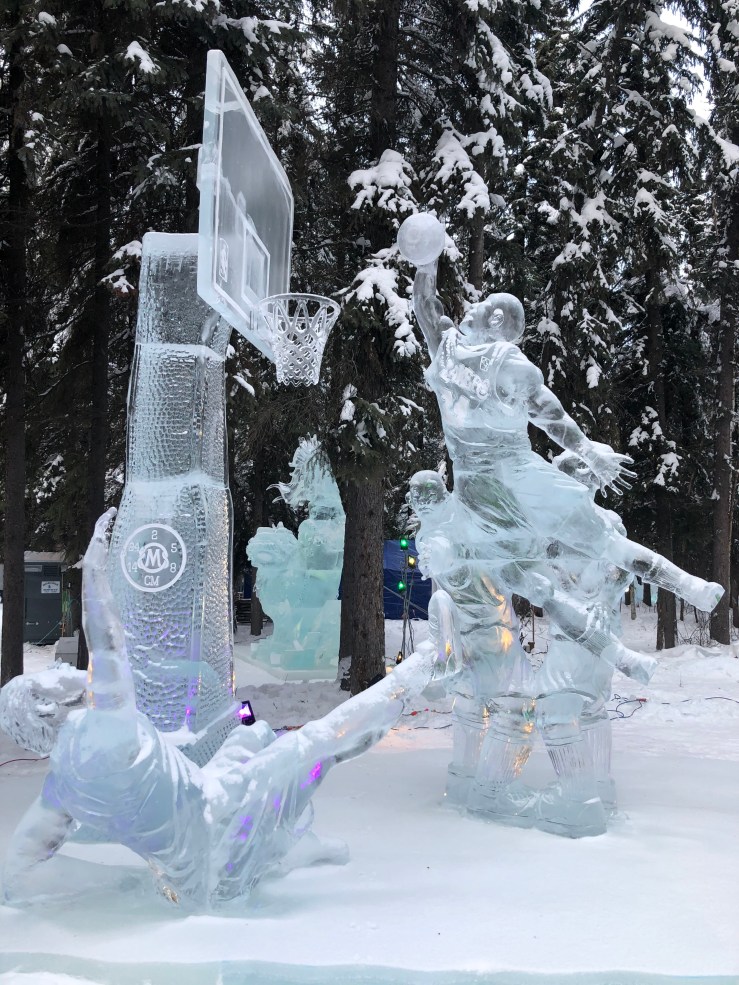
The subject matter of the sculptures are as varied as the artists that created them.  They come from all over the world – Japan, Latvia, Canada, Russia, Alaska – to try their hand at winning over the judges with their piece. A sculpture called “The Heart of the Universe” exudes power and presence through ice spikes that radiate outwards.  In “The Blessing of Baikal” a mythical father bestows a blessing upon his river-daughter before she flows away from him.   There is a tribute to Kobe Bryant, the basketball player, at his untimely death, as he towers high above his teammates, caught in the action of the game, dunking the ball into the net.  “Not Forgotten” pays homage to fallen veterans, in the figure of a motorcyclist who stops at the half- open gate of a cemetery.

IceArt3


Later this Spring, the sculptures will slowly disappear, acquiescing to a gentler season, but their thawing will not lessen the fortitude they showed in the winter. We will recall them in our memories, how they glittered in the sun, were shaped by wind and reflected in the changing light. It is earth art at its finest, drawing attention to the landscape precisely as it is returned to it.


Winter Escape to Maui

“It’s almost Mai Tai time!”

Not one person on the airplane was in a bad mood. We were, after all, trading a long stretch of Alaskan subzero temperatures for the soft balminess of the Hawaiian island of Maui. Among cheering and clapping, the airplane descended slowly into a valley, between mountains, coned and lush and green, in tropical contrast to the white landscape we had left behind.  We alighted, felt the silky, warm air on our skin, looking distinctly Alaskan in the bulky layers we were still dressed in.

“I want to see a black lava beach!” Helen announced excitedly.

“Let’s hike onto a volcano!” was Yanni’s agenda.

I wanted merely to sit on a lanai surrounded by blooming bougainvillea and hibiscus.

The pretext for our trip was Nick’s continuing medical education seminar. He needed to attend a certain number of these, to accrue the necessary credit hours in order to remain in good standing with Alaska medical licensure.  For the rest of us, it provided the perfect excuse. I had leafed through his continuing medical catalog, looking up conferences in sunny destinations that I felt he could “benefit” from, topics he should learn about. Beaming, I presented him with a conference in Maui: “Topics in Internal. Medicine”.  The kids and I would tag along on Alaska Airlines companion fare tickets. Who, after all, was better equipped than us to make sure that Nick would attend most of the lectures?

It did not take long for us to quickly immerse ourselves into a time that seemed to, suddenly, stand still.  We switched momentum in minutes, on this volcanic island, thousands of years in the making, erupting, then cooling, the cratered summit of Haleakala still standing tall at its center.  We eased, stepping into the slower rhythm of this island paradise.  We languished in wicker chairs beneath gently swaying palm trees, felt the warm sandy beach between our toes, tasted sweet pineapple chunks. Nick joined us, cutting out of seminars early. Shorts and flip-flops had replaced his khakis and button-down shirt.

Maui3


In order to imbue some culture into the kids, I roused them occasionally from their recliners by the swimming pool to go on an excursion. We walked along the coastal trail to Honokahua, an ancient burial mound, where, according to Hawaiian belief, ancestor spirits still watch over the land and the people.  At sunset, we paid attention to the blowing of a conch shell, serving a practical purpose in ancient times, for those in canoes who sought the welcome and direction from those on land. Nowadays, the ceremony, symbolically performed to summon mana, energy, from all four directions, still resounds in its effort to say mahalo, thank you, at the close of the day.

Enough of philosophizing, we decided, when the ceremony drew to a close.  Our thoughts veered instead towards what we should eat for dinner: mahi mahi or shrimp tacos or huli huli chicken.  Deliberations about which eatery we should frequent absorbed a good portion of our enthusiastic discussion every evening. In our food-obsessed family, no meal would ever go unheeded.

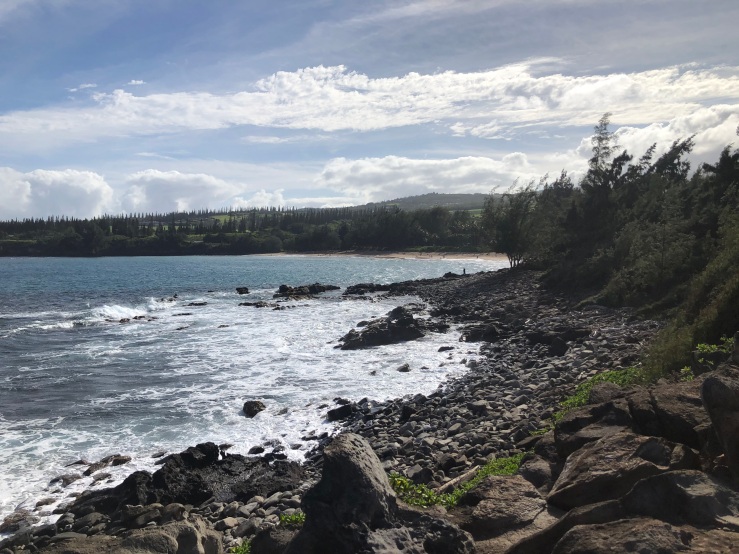
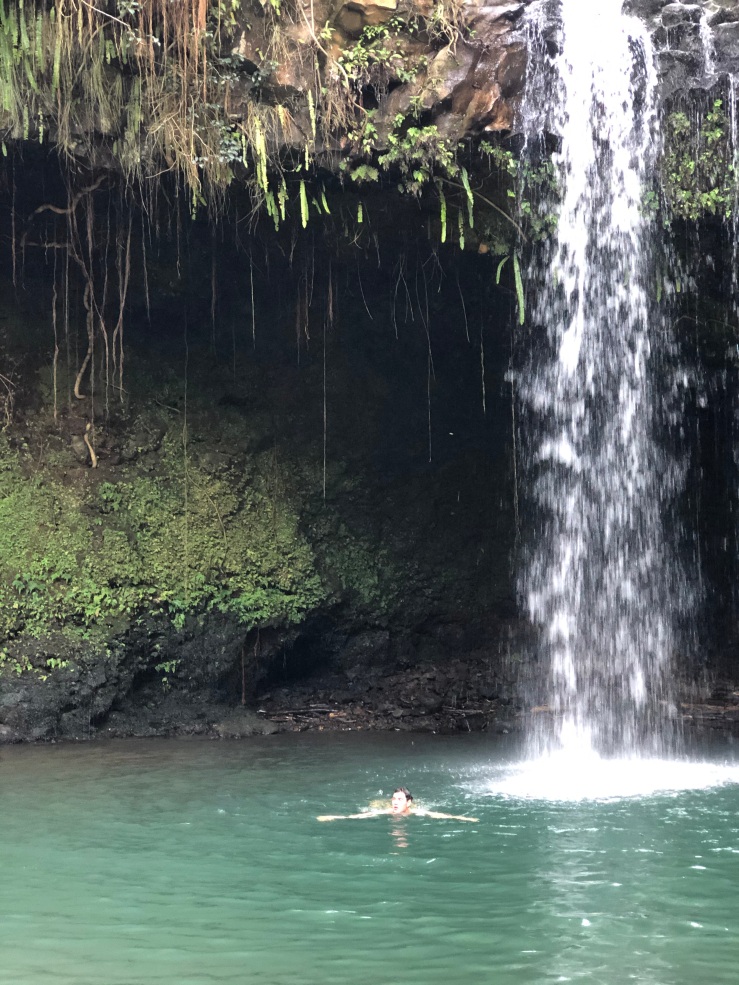
Other times, we absorbed the landscape.  A stony labyrinth, built of rocks and grass, on a rocky outcropping overlooking the crashing, spume-covered waves, provided the perfect earthwork, through which we slowly walked, following its unicursal path.  In Lahaina town, we stood beneath an enormous banyan tree, whose aerial roots covered an acre, spreading a huge canopy above us.  We hiked through bamboo thickets, coming across twin waterfalls cascading into a shadowed rock pool when we were only looking for a stream. We stopped, enthralled.

Maui2


Hawaii is enchanting, drawing us in with its waterfalls and fragrances and sea vistas.  By the end of the week, I am, however, ready to return to Alaska. I miss the quiet winter, the frozen lakes, the snow-covered hillsides. If Hawaii is a love story, toying with pleasure, satiating my senses, then Alaska is still tugging at me like the old trusted friend I have left behind.


Ice Fishing in Alaska

“It’ll be fun!” the teenagers told me.  “We’ve figured out a fishing hut on the Tanana Lakes!”

After a four week stretch of temperatures hovering near 400 below in Alaska, cabin fever had firmly entrenched itself.  All of us were weary of slouching around the house.  Now they were suggesting a different type of cabin for diversion:  an ice fishing shack.

Hmmmm…

Not much of a fisherwoman myself, I was immediately skeptical.  In summers past, my family had persuaded me to go “combat fishing” in the Kenai River for salmon, standing shoulder to shoulder in the blue green water while the fish slunk around my waders.  Despite all patient instruction, I succeeded only in snagging my fishing line on rocks lining the riverbed and casting about in all the wrong directions.  It wasn’t long before I gave up, opting to sit in our boat, poured the hot water designed for our coffee thermos over my frozen toes, and munched on goldfish snacks.  Later in the summer, my family once again convinced me to go fishing, this time a halibut charter in Kachemak Bay.  This should be easier, I thought, when I saw the well-equipped boat in Homer’s harbor, fishing poles lined up already against the railing, bait attached, guides at hand to help.  Not long after we left the relative calm of the bay, however, the swells surged, rocking the boat wildly, and more than one of us leaned over the railing, upchucking our breakfasts.

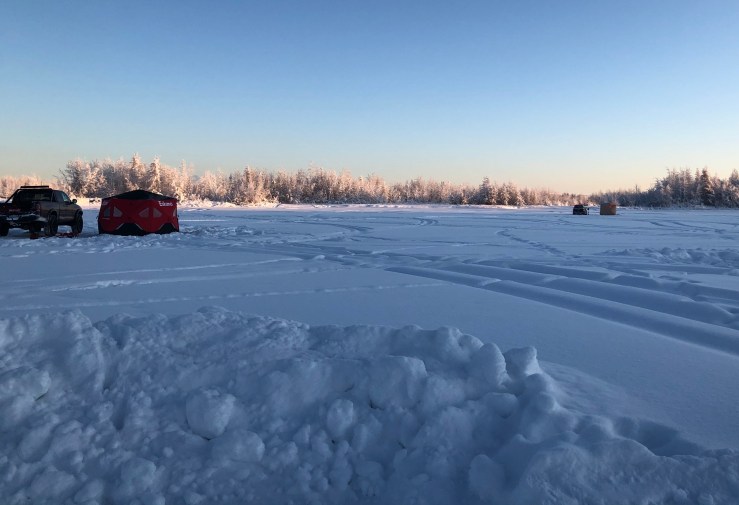
Maneuvering to the edge of the expansive lake, I surveyed the fishing “huts” scattered across its frozen surface.  They ranged from primitive tents set up over self-drilled holes in the ice to campers to wooden structures complete with a wood burning stove, smoke curling upwards. Our particular exemplar, a wooden shack, stood in the middle of the lake, having been dragged out across the ice earlier in the winter.  I eyed the ice, thicker at the edges of the lake, and took courage from the fact that other vehicles had already driven across safely.

FB1AF26C-B076-43F8-989B-6D48A33CF6CE_1_201_a

Inside, the hut was furnished with just the basic necessities for ice fishing.  It was dimly lit because of its lack of windows but warmed from the wood stove the boys fed with logs.  The wooden planks of four corners of the hut had been removed, exposing the ice below, and drilled into this were four fishing holes.  All in all, the effect resembled an outhouse.

The teenagers had already started fishing, each facing a corner, dropping lines into the holes.  Light shimmered from below, casting an eerie glow into the dimly lit hut.  Far below the ice, whitefish and rainbow trout and arctic grayling swiveled, dodging the bobbing lead weights which the boys had hooked with salmon eggs.  Every so often, they used a ladle to break up the ice crust forming over the fishing holes.

I settled myself on a metal camping chair to await the result of their efforts.  After an hour passed without a single tug on the fishing line, I started to question the whiteboard tacked onto the wooden wall onto which previous hut inhabitants had recorded their successes. On January 6 someone caught over 120 fish using small rubber jigs.  On January 14 three people caught about 100 fish between them, using shrimp as bait.  Perhaps we had picked the wrong time of day?  Or were dropping our lines too low?  Or maybe the fish were just outsmarting us.  And then, of course, I pondered the wisdom of this catch-and-release sport…

When I grew stiff from sitting, I left them to their ruminations about how to best hold the line, or to switch out the bait, or to change the music to Taylor Swift, in case that was more along the acoustic preference of the fish.  Outside, after the gloom of the hut, the sun was bright on the snow-covered lake, the air still and crackling and cold.  My walk, though not long in the subzero temperatures, took me a distance across the lake.  I looked back towards the fishing huts, quiet and tranquil. In the end, the kids managed to catch a multitude of fish that day. Once they properly determined the right bait and depth, they caught fish after fish while I, once again, did not hook even a single one. Fishing may just not be my sport, I conceded. The white silence on the lake that day, however, was enough for me to join in on yet another fishing venture anytime.

Winter Solstice in Alaska

“I’ve been up for hours and it is still dark outside!”

The complaint is justified, at this time of year, when the sun, in its best effort, follows a shallow, horizontal arc along the horizon, never really rising well above the Alaska Range. The day is marked by dusky metallic light, slanting in at an angle, a mere three and a half hours in duration.  Overnight, the temperatures plummet to 320 below zero.  The cold snap is predicted to last for several days yet.  We cover our noses and mouths with thick scarves when we go outside, but the hairs in our nostrils still tickle as they freeze.

It is the winter that sets us apart from the rest of the world.

“How can you bear it?” my friends in the Lower 48 States ask.  “Is it not terribly cold and dark?”

Indeed, it is a formidable winter.  Ruthlessly frigid.  Dangerous, even, if one is not clad in proper clothing.  But there is so much to love about the winter as well, I tell them.

Practicalities sometimes become easier. It is so cold that the roads, under a packed sheet of snow and ice, have the texture of sandpaper, less slippery, much easier to drive on.  In town, the parking meters have stopped working and we do not have rummage for quarters anymore.  Chores around the house lessen because it is too cold to concern ourselves with outdoor tasks.  The ones that we do still have, such as picking up after the dogs, is made simpler because the dog poop is frozen solid in the snowy yard.  We never run out of room in our freezer because we can place our dinner leftovers onto the porch, a natural outdoor freezer.

On an aesthetic level, we cherish the crackling, still, white world. Someone has hung Christmas ornaments along intermittent tree branches along our favorite walking trail through the woods.  We follow these, bundled into heavy parkas and boots, as the sun rises behind the spruces and birch trees. By the time we get back to town, dusk is already falling.  Outdoor Christmas lights, turned on early in the year to offset the darkness, cast a comforting golden glow onto the snow outside. In the pitch-black nights, the northern lights are clearly visible, wavering like a green curtain, extending into the Tanana Valley below. The stars, defined sharply in the crisp air, look like they can be touched.  It is as though we are, literally, on top of the world.

For one night, midwinter, the North Pole attains its maximum tilt away from the sun. The longest night of the year is upon us.  Just when we think the cold has lasted too long, we celebrate the winter solstice and its promise of returning light. What good is the warmth of summer, wrote John Steinbeck, without the cold of winter to give it sweetness.

This is precisely what our winter, rugged and fierce and beautiful, reminds us every day.


WinterSolstice3