Traffic Jam in Alaska

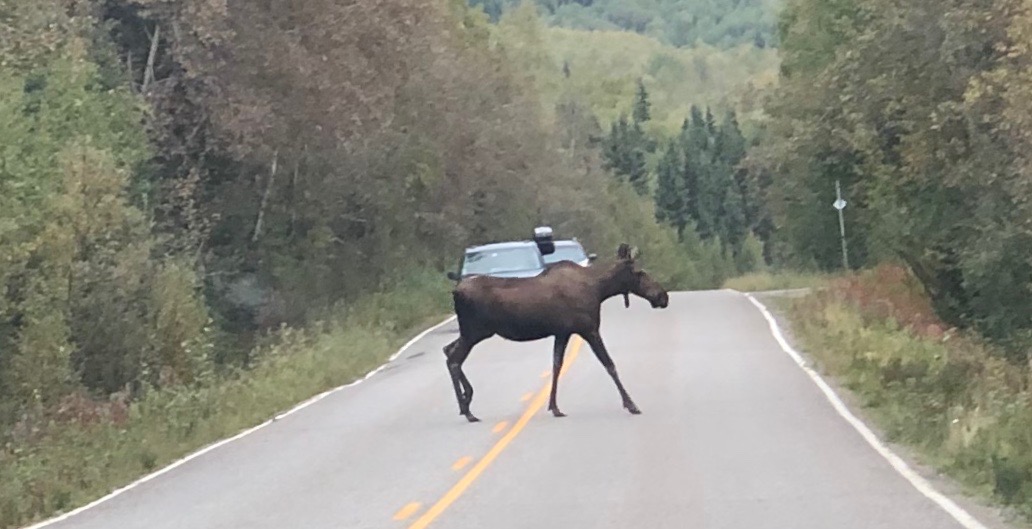
Autumn and I breathe a sigh of relief.  Time slows, evenings lengthen. Whatever summer activities, multiplied and frenzied beneath a midnight sun, slowly wean themselves in the tempered days of fall.  I have hiked the trails – Chena Dome and Angel Rocks and Rock River Trail.  The Tanana Valley State Fair came and went, with rides and Polish dogs and Cajun shrimp.  Flowers and vegetables have been coaxed to unimaginable heights in the almost continuous daylight.  The seafood freezer is full, crammed with salmon dip-netted from the Chitina River and halibut from Katchemak Bay. Summer visitors have left, taking home with them images of floating down the rivers, eating crabcakes at the Pump House, and of Denali National Park. And I can settle, glad for the quieter seasons to come, with days eased to a slower tempo, when a moose crossing the road is the only traffic jam in my day.


Autumn in Alaska

Autumn arrives explosively to the interior of Alaska. There is no gentle transition into it. Instead, the season arrives with such an extravagance of color that its impression will last in my mind well into the long winter to come.  Birches turn yellow and amber, the muskeg rust colored, the lichen white.  The air is crisp and clear, the sky cerulean and expansive.

It is time to prepare ourselves for the upcoming winter. We harvest the last of the vegetable garden, knowing that soon moose will amble up close to the house, searching for remnants. We clean up the yard, and store garden furniture, and unhook outdoor faucets before the first frost.  We stack wood for the fireplace. Whatever we don’t know what to do with, we conceal beneath a large, blue tarp, tucked away in the corner of the garden.

Summer tourists have gone. Hunting season has begun. In camouflage, with guns propped onto four wheelers, hunters populate the hills north of town, scoping for a moose with a legal antler span.  In the mountains, caribou and Dall sheep and bears forage for food before the snow sets in. Closer to home, we comb the slopes for tart blueberries and high bush cranberries, the last of what the earth will yield to us, which we save for jams and sauces and scones and pancakes,

I settle, after the tumult of the busy summer season, to enjoy the colors.  I go for long walks, with a pair of dogs and sweeping vistas from higher elevations. With a bit of luck, I am rewarded with a glimpse of Denali’s peak on the horizon, across a tundra turned flaming orange. Autumn is achingly short lived. But just long enough to remind me of yet another reason I live in Alaska.


Equinox Marathon in Fairbanks, Alaska

I was filled with nervous energy.  I had hardly slept the night before, checking the running gear I had laid out, again and again.  Moisture wicking layers, running tights, headphones, number bib, Stinger lemon wafers for fuel.  I had signed up to run the Equinox Marathon in its entirety this year, in an effort to raise funds for leukemia research with the Fairbanks Chapter of Team in Training. We had trained for the whole summer together, building up to our longer runs, supporting each other with every new milestone.  All of a sudden, I wondered about the sagacity of this decision.  Did I really have a marathon in these legs of mine?

On the morning of the race, September 21, fog hung low and a cold drizzle blanketed the starting line on the campus of the University of Alaska in Fairbanks.  The atmosphere was charged, however, brimming with excitement that could not be dampened by the weather.  Runners wore gloves and headbands and rain repellent jackets over their running gear. These warriors were eager to take on one of the most challenging marathon courses of the world, a brutal course, mostly on trails and gravel roads, through woods, up Ester Dome with an elevation gain of 3,285 feet, along an “out and back” on the top, down a steep “chute” on the other side, then back to town.

When the sound of a cannon resounded, I was caught up in the start among hundreds of others, all charging up a steep hill that, a few weeks later, university students would sled down.  I was out of breath immediately.  I looked around for teammates in purple clothing, familiar faces. We were soon scattered apart in the crowd.  I would find them down the trail, I thought, as I headed into the woods.  We ran along muddy, softened, slippery trails, feet sliding, catching our balance, in the steady rain.  Roots and rocks were slick, ready to trip us.  It would be a hard course today. Where was the beautiful autumn day, birches turned crimson and yellow, sky bright blue, air dry and crisp, that I had hoped for?

Despite the dismal weather, bundled up spectators stood alongside, cheering, ready with “high fives” and encouraging hugs, braving the cold, and I was reminded again of the reason I love Fairbanks.  There were water stations every few miles, with volunteers handing us cups of water or Gatorade.  On the trail, tables were set up, offering beef jerky, salty snacks, coconut cookies, grapes, even beer.  We look out for each other.  Maybe it is what Alaska is all about.

Eight miles later, approaching the first relay changeover, I anxiously peered towards Ester Dome.  Its summit was shrouded in greyness, a premonition of the snow that had been predicted.  The climb up the dome is arduous even in the best of conditions.  Today, when we finally emerged from the woods onto the road that leads to the top, biting wind and sleet came at us at an angle.  Within moments, my layers were drenched, my fingers numb, my confidence bottomed out.  I hadn’t even made it to the halfway mark yet!

But then, just as I was seriously considering dropping out of the race, I made it to the Team in Training tent at the top.  There, amid coaches who helped me find dry socks and new layers, who offered hand warmers and hot water to drink, I felt bolstered again.  I would take on the “out and back”, that deceiving portion of the course that descends from the top, only to make us turn around and climb back up again.  I was encouraged by volunteers even there, near mile sixteen, huddled together at a water stop, next to a fire they had made to keep warm.

“You’ve got this!” they shouted.  “Just the chute.  It’s all downhill now!”.

I scrambled and slid down the steep descent, hoping to not break a leg in the process, trying not to think of the pain in my quads.  As I hobbled down the Alder trail, somewhat more level, with six miles to go, I channeled into my mind the mantra on our training jersey: “We don’t know how strong we are until being strong is the only choice we have.”

And I understood, suddenly, what this race was all about.  It was not about me.  It was about the camaraderie that the participants implicitly developed, all faced with the same challenges that day. It was about the volunteers that had come out to support us, despite mud and rain and sleet, shouting out our names, staying until the last of us had passed.  It was about the coaches, who gave their time over and over again to help us achieve our goal. I felt strong, then, knowing they had my back, that we were all in this together.  We had all defeated the weather.  We were stoic and determined and strong-willed.  And we would all cross that finish line.


PNWA Writer’s Conference

At the Pacific Northwest Writer’s Conference in Seattle last weekend, I scrambled to fit in everything I wanted to attend.  Workshops on topics ranging from creating dazzling characters to writing irresistible nonfiction book proposals to establishing an author platform.  Agents and editors, representing every possible writing genre, all at such close hand.  Featured speakers.  Dinner receptions.  Opportunities to mingle and learn and promote my writing.  I tingled with excitement and the promise of a literary future.

My excitement had set in well before the first pitch.  But then, as I saw the long queues of writers, lining up for their first attempt to sway an agent into seeing the worth of their writing, their story, something seized tight within me.  How could I measure up?  A woman behind me asked what I had written.  Memoir, I answer.  A story about leukemia that is tied to Alaska, my home, my heart.  Will that sell? she asks.  I stare back at her.

I sit at the pitch table and am finally getting comfortable with the agent in front of me.  Grey hair, lovely demeanor.  Can she even hear me in this din?  She asks questions and I want to spend an hour talking to her.  She seems genuinely interested but is cut off, mid-sentence, by the buzzer.  Drrrinnngg.  Changeover.  Four minutes is all you get.  To tell your story.  Your ambition.  Your life.  A buzzer on life?

In line again, I scan the writers around me.  I am not alone.  A man, eyes closed, nervously gesticulates with his hand as he silently practices his pitch in his head.  Two women, perhaps a decade older than myself, smartly dressed, are exchanging notes on an agent.  An overconfident young man, wearing faded jeans and a baseball cap, talking loudly about his success at the the last writer’s conference he attended.  Two requests for chapters, one for the full manuscript.  Had it not gone any farther than that?

Wait.  Stop.  We are writers.  This, precisely, is the very stuff that our stories are made of. Doubt and sweaty palms.  But also resilience after multiple rejections.  And, always, lingering, a pride, especially when writing is not always fearless.